• This is default featured slide 1 title

    Go to Blogger edit html and find these sentences.Now replace these sentences with your own descriptions.This theme is Bloggerized by NewBloggerThemes.com.

  • This is default featured slide 2 title

    Go to Blogger edit html and find these sentences.Now replace these sentences with your own descriptions.This theme is Bloggerized by NewBloggerThemes.com.

  • This is default featured slide 3 title

    Go to Blogger edit html and find these sentences.Now replace these sentences with your own descriptions.This theme is Bloggerized by NewBloggerThemes.com.

  • This is default featured slide 4 title

    Go to Blogger edit html and find these sentences.Now replace these sentences with your own descriptions.This theme is Bloggerized by NewBloggerThemes.com.

  • This is default featured slide 5 title

    Go to Blogger edit html and find these sentences.Now replace these sentences with your own descriptions.This theme is Bloggerized by NewBloggerThemes.com.

Showing posts with label heidi. Show all posts

Heidi: Todos Los Episodios (en Espanol)


In the United States, Isao Takahata is best remembered for his Studio Ghibli movies, including Grave of the Fireflies and The Tale of the Princess Kaguya. In Europe and Latin America, however, he is remembered for Heidi, the landmark 1974 animated series that became a household name to children all around the world. The series has been shown in over thirty countries and translated into twenty different languages.

Here is the Spanish-language version of Heidi, all 52 episodes complete and uncut. Since half of our household is Colombian, these videos will be most welcome.

I really like the rich color saturation in these video transfers. It looks like it was translated directly from 35mm film, which is how the series was originally shot. Yes, there is a lot of color bleed and fuzzy NTSC resolution, but this only adds to the warmth and nostalgia. The Spanish-language dub is also quite excellent, much better than I expected. I might have to stop watching episodes of my fan-translated copy (using video sourced from the Japanese Blu-Ray) and start watching this instead.

Enjoy Heidi todos los episodios en Espanol! Yay!
Share:

A Great Cartoon Scene in Heidi Episode 1

Heidi, Girl of the Alps

Heidi, Girl of the Alps

Heidi, Girl of the Alps

Heidi, Girl of the Alps

Last night, I played the first episode of Heidi, Girl of the Alps. It was the first time I had watched for a couple years, and this is one of my all-time favorite Isao Takahata classics. Like many of you, I am far too upset and heartbroken to even think about watching something like Grave of the Fireflies or The Tale of the Princess Kaguya. Let's just play in Heidi's happy world for now.

Episode 1 is absolutely fantastic and packed with boundless energy and an amazing assortment of compositions, layouts, and art designs. And there are more than a few genuine comic moments. Here is one such example. It's a brief shot where Heidi sees Peter the shepherd boy sprinting down the mountain, and she wants to charge after him. Notice her wind-up pose, which is a wonderfully funny cartoon pose. Heidi begins to dart forward, arms outstretched. The aunt suddenly sees this, and with a very subtle movement, grabs Heidi by the back of her shirt, pulling her back. Heidi's reaction poses are terrific, as she is literally yanked back into place with a baffled look on her face.

Note how Heidi gets all the action in this cut. She gets the dynamic poses and the classic cartoon movements that are only very slightly exaggerated. The aunt, meanwhile, is animated in a "realist" manner, with little movement, a tilt from left to right. Note, also, how Heidi darts into the picture frame at an angle. This episode is packed full of these three-dimensional compositions, as characters move at varying diagonal angles, many times brushing right up against the "camera." This was a technique that Takahata obsessed about in Horus, Prince of the Sun, and now he takes that to the next level.

Heidi, Girl of the Alps is grounded very firmly in realism, with a strong emphasis on documentary details of daily life and complex character melodrama. These elements are also balanced by classic cartoon gags and poses. It's much more restrained than, say, Lupin the 3rd, which can veer from James Bond to Road Runner at the drop of a hat. Isao Takahata, Hayao Miyazaki and Yoichi Kotabe succeed in finding just the right balance for Heidi.

Compare Heidi episode 1 to any American cartoon show from the same era. The difference in visual technique is absolutely staggering. Hanna-Barbara and Filmmation are great, but they're stuck very firmly in a 2D world. Paku-san is obsessed with moving in a fully 3D world, mimicking the look of classic cinema as much as humanly possible. Today, this sort of thinking is commonplace and nobody bats an eye. But in 1974, just as in 1968, this was radical and revolutionary. Nothing like this had ever been seen before.

What a magnificent series. I feel like I could write a book just about this one episode. Heck, maybe I ought to try? Any takers on that? Anybody interested? Bueller?
Share:

Heidi, Girl of the Alps (1974, 52 Episodes, English Subtitles)


Whenever I am asked what is Isao Takahata's greatest works, I always say, simply, "Heidi Marco Anne." Those three television series are his crowning masterpieces, and the epic novels to Studio Ghibli's short stories. This series became a blockbuster smash success in Japan, and was soon exported to nearly every nation on the globe. Everywhere except the USA, that is. D'oh!

This week, in many parts of the world, Isao Takahata will be remembered as the director of Heidi, that beloved animated series that became the soundtrack to so many childhoods. Meanwhile, many of us who have never seen this program can discover it and be amazed, dazzled and overwhelmed.

This is a fantastic series. Of the "Heidi Marco Anne" trilogy, my personal favorite is Marco, but there's no denying the brilliance and boundless charms of Heidi. This masterwork, more than any other, is the defining paradigm of the Studio Ghibli movies. This is where Miyazaki found his best inspirations. And I think there's at least one "Ghibli Riff" in all 52 episodes.

This series is really a team effort between Takahata (director), Miyazaki (layout and design) and Yoichi Kotabe (animation director, character design), and they should all share credit. But it's Paku-san's genius and vision that made this work a reality. It was he who wanted to create a cartoon melodrama that celebrated daily life in almost documentary detail. It was he who wanted to push the emotional boundaries of the medium. It was he who wanted to shatter the "kiddie cartoon" archetype and create true literature. Heidi may not be as dark or moody as Horus, Prince of the Sun, Takahata's revolutionary 1968 feature film, but it's just as important a milestone in the evolution of anime.

This is a fantastic series. I wish GKIDS would just pay the ransom money and release the series in the US. These fan translations are terrific, but I'm really hungry for a proper Blu-Ray box set.

Here is the entire Heidi series, all 52 episodes, with English subtitles. Enjoy!
Share:

Riffs: Heidi, Girl of the Alps, Omohide Poro Poro


Riffs: Heidi, Girl of the Alps, Omohide Poro Poro

Riffs: Heidi, Girl of the Alps, Omohide Poro Poro

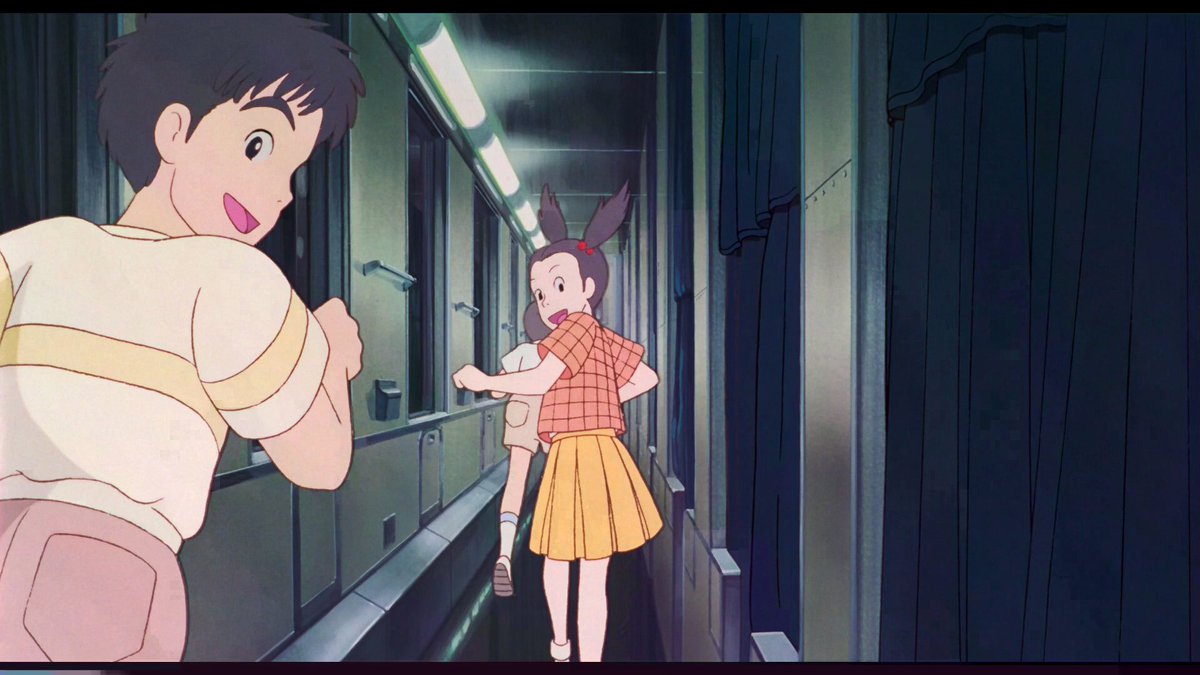
Of all the great works in the Hayao Miyazaki-Isao Takahata canon, it is Heidi that stands tallest. At least where the riffs stand. Nearly every one of the 52 episodes from the groundbreaking anime series has been quoted in the directors' later works. For those of you playing the "Ghibli Riff Game", you will never truly become a champion until you've spotted all those Heidi moments.

Here is but one terrific example. This shot from Omohide Poro Poro (Only Yesterday) of children running down the aisle of a train passenger car is directly quoting a shot from a later episode of Heidi, one in which the title character, her "Alm-Uncle" and her friends spend a vacation at the ruins of a great castle. Notice how characters wink back at the camera as they skirt on by. That's a very sly shot.

One extra riff tidbit: the Heidi episodes set at the castle (a completely original plot line that was never in the original Johanna Spyri novel) were later riffed in Lupin the 3rd: The Castle of Cagliostro, when Lupin and Jigen encounter the ruins of the Cagliostro family castle. And the elderly groundskeeper who speaks to them? He is voiced by the same Japanese actor who voiced the Grandfather in Heidi.

Better learn your Ghibli Riffs, kids.

P.S. I've been holding onto that Heidi screenshot on my computers since 2005, when I bought a Taiwan DVD Heidi box set and watched the whole series. No, there were no English subtitles, which was unfortunate, but I was able to follow pretty easily in my crummy toddler-level Japanese grammar skills. I'm still not any better.
Share:

Video: Heidi Meets Super Mario Kart


This Heidi-meets-Super-Mario-Kart video never gets old. It always leaves me with a big, silly grin. Why can't somebody make a real video game like this? I'd pay good money to play. Wouldn't you? Of course, you would.
Share: