The World of Hans Christian Andersen is the American title to the 1968 Toei Doga animated feature Andersen Monogatari ("The Story of Andersen"). It was released in the US in 1971 by United Artists, in partnership with the legendary Hal Roach Studios, who handled the English-language dub.
Showing posts with label reviews. Show all posts
Movie Review: The World of Hans Christian Andersen (1968)
The World of Hans Christian Andersen is the American title to the 1968 Toei Doga animated feature Andersen Monogatari ("The Story of Andersen"). It was released in the US in 1971 by United Artists, in partnership with the legendary Hal Roach Studios, who handled the English-language dub.
The movie tells the tale of a young Hans Christian Andersen, who meets a magical storyteller who arrives to Earth from Heaven in order to guide the boy and inspire his talents as a storyteller. As young Hans observes the lives of the villagers around him, we see the trappings of the fairy tales that would make him famous. There are cartoon mice, cats and dogs, as well as about a hundred song-and-dance numbers.
Personally, I am not a great fan of this movie. Of all the Hiroshi Okawa-era Toei Doga movies (1958-1972), The World of Hans Christian Andersen feels the most formulaic, the most cliched, the most, shall we say, Disney-esque. In every way, it is a stereotypical "family cartoon" with sing-along songs, simple characters, contrived plot points, and an overall atmosphere of suffocating niceness. The swelling strings of the orchestra are pure cheese. This is a movie very specifically made for very small children who would be easily distracted and amused.
What made the classic Toei movies so compelling is how they learned the lessons of Walt Disney without copying his movies. Instead, they learned to adapt their own folk tales and legends, learned how to incorporate a purely Asian flavor to their animated features. In time, the animators learned new ways of expression, and new paradigms emerged which eventually became "anime." This movie, however, represents a massive thrust backwards. It is nowhere near the level of Hakujaden, Saiyuki, or Little Prince and the Eight-Headed Dragon, Toei's best animated features up to that point.
Here's why I believe that happened. This movie was released in March of 1968, ahead of another Toei feature that was supposed to be completed and released earlier. It's name: The Great Adventure of Horus, Prince of the Sun, the revolutionary anime masterpiece directed by Isao Takahata and helmed by Hayao Miyazaki, Yasuo Otsuka, Yoichi Kotabe, Reiko Okuyama and Yasuji Mori. The battle to create Horus lasted the better part of three years, ran massively over-budget and severely damaged relations with the production staff and its labor union (of which Takahata, Miyazaki and Otsuka served leading roles).
To the studio bosses of the day, Horus was an albatross, a dark, brooding, violent mess that would almost certainly give children heart attacks. It might even scare them away from Toei forever, into the waiting arms of rival animation studios that were flooding television screens. Something needed to be done to keep that traditional audience in place, and to prevent them from fleeing.
I believe this is the reason why Andersen Monogatari was made. It is the safest and most "child-friendly" movie the studio had ever made. It was a purely defensive move against a feared backlash, to say nothing about recovering all that money that was being spent on Horus (which ended up being the studio's biggest box-office flop, but that was at least partly due to studio sabotage as anything).
Hans Christian Andersen is not a bad movie. It's just very uninspired and very, very "safe." It could have been assembled by committee, and very likely was. To be fair, all the studio's best talent was locked up with Horus, leaving very few skilled animators or artists available for anything else (Jack and the Witch, Toei's 1967 feature, suffered from the same problem). The animation is lacking any real spark or inventiveness, never straying from the instruction manual, it seems. The story lacks inspiration in its characters or setting.
In the movie's defense, I do enjoy the "Little Match Girl" story thread the weaves in and out and supplies the climax. Here, the movie seems to have found a proper balance, striking an emotional cue that is fitting to Andersen's stories. The movie ends on a strong note. It probably doesn't matter that before the year was out, Horus, Prince of the Sun would completely demolish it to rubble. The World of Hans Christian Andersen is like that act on The Ed Sullivan Show that came on stage just before The Beatles. Does anyone remember that guy? No, of course not. Which is precisely the point.
P.S. The World of Hans Christian Andersen was recently uploaded to YouTube, in the original Japanese, where one person noted that the movie's final 25 minutes syncs up perfectly with David Bowie's Low album. That gave me a chuckle. These are the sort of things that make me question if we're really living in The Matrix.
Hayao Miyazaki Short Films: Mei and the Kittenbus (2003)
UnknownOctober 11, 2017ghibli museum, ghibli shorts, my neighbor totoro, reviews, screenshots
No comments
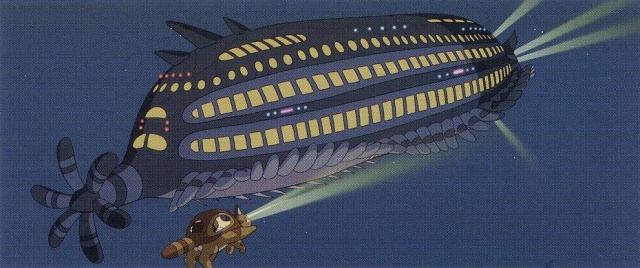
Here are some photos from the 2003 Ghibli Museum short film Mei and the Kittenbus. Directed by Hayao Miyazaki, this is a sequel of sorts to the beloved children's classic My Neighbor Totoro.
Mei and the Kittenbus is fairly short, roughly ten minutes. In the first sequence, young Mei playing around her family house until she discovers a new friend, the "kittenbus," who is a pint-sized version of Catbus. The two play and frolic around and have a good time.
In the second sequence, Mei is awakened at night by Kittenbus, who takes her on a journey, where they discover dozens of "cat buses" of all shapes and sizes, and populated by hundreds of large Totoros. Everyone is joining together to meet the elder Catbus, the oldest and largest of them all (and voiced by Miyazaki himself). Here, Mei is reunited with Totoro, who is still carrying his umbrella.
Everyone is happy and cheerful. Mei is returned to her home, and the story ends.
While this film, like all the Ghibli Museum short films, remain exclusively in Japan, Westerners can purchase the official art books, which include large screenshots detailing the stories. These are nice collectibles and very valuable for scholars who wish to discover this little-known aspect of Studio Ghibli.
Will Mei and the Kittenbus ever be shown outside of Japan? Not likely, at least not while Miyazaki is still alive. The museum was created with a decidedly non-commercial approach, deliberately avoiding the mass consumerism of a Disneyland. Because of this, the museum's short films are intended to be seen only there, with no possibility of a home video release.
Even after Miyazaki passes (hopefully not for many more years), Toshio Suzuki will likely still honor his friend's wishes. Whoever ends up controlling Studio Ghibli after the original founders are gone will likely decide the fate of these movies. But that's not a conversation we're ready to have, for obvious reasons. I'll gladly prefer to keep these movies in the vault in exchange for keeping Miyazaki around a little longer.
Movie Review: Ghiblies "Episode 1" (2000)
The cartoon is a spoof of Studio Ghibli, and all of the characters are based on the staff, led by the Machiavellian Toshio Suzuki, who seems to delight in tormenting his workers. One interesting character is a ghost who is actually a corporate spy sent by a rival animation studio, but chose to remain as part of the Ghibli staff. Much of the material seen in this special was later reworked in the 2002 theatrical short Ghiblies Episode 2.
The art and animation design follows the sparse watercolor approach as My Neighbors the Yamada, which, at the time, was the latest feature film by the studio. This is an interesting approach, as Yamada was a box-office bomb and the studio's biggest commercial failure (one would think Ghibli would want nothing to do with it). There may also have been a rift between the two directors, which led to Takahata's withdrawal from directing. In the 2013 documentary The Kingdom of Dreams and Madness, Miyazaki is still visibly upset about Takahata's management of Ghibli during the production of Yamada, where the studio restructured from cel animation to computers (all subsequent Ghibli movies have been created digitally).
In 2003, Takahata contributed one short scene for the anthology film Winter Days, and then returned for the 2010 Anne of Green Gables anthology movie that was given a brief theatrical run. The Tale of the Princess Kaguya would arrive three years later, receiving an Academy Awards nomination.
It's fascinating, then, to see Ghibli return to that watercolor style for a number of short film projects, including Ghiblies. It speaks well to their talents as artists that they are willing to continue the visual experimentation. Working in television also gave them an added degree of freedom, creating some of the studio's best work.
Both Ghiblies episodes were directed by Yoshiyuki Momose, who by all measures was the studio's true heir to the director's chair. He directed three Capsule music videos in 2004 and 2005, which are probably my favorite animated shorts created by Ghibli (specifically, Ghibli offshoot Studio Kajino). He developed a unique way of joining hand-drawn and computer animation that is wholly unique, and suggests an alternate future where Studio Ghibli, and anime in general, could have evolved. Why he was never given a feature film to direct remains an astonishing mystery, and an astonishing blunder.
In any case, get your hands on Ghiblies "Episode 1" by any means necessary. And tell Studio Ghibli to release it on home video, already. Shut up and take our money!
Update: Oh, look, somebody uploaded it to YouTube. It plays at double the speed, presumably to evade the copyright bots, and the subtitles are in French, but you'll be fine.


